
Between the pressure bag and the IV pole.
Nothing between them is powered, hands-free, and small enough to carry to the patient.
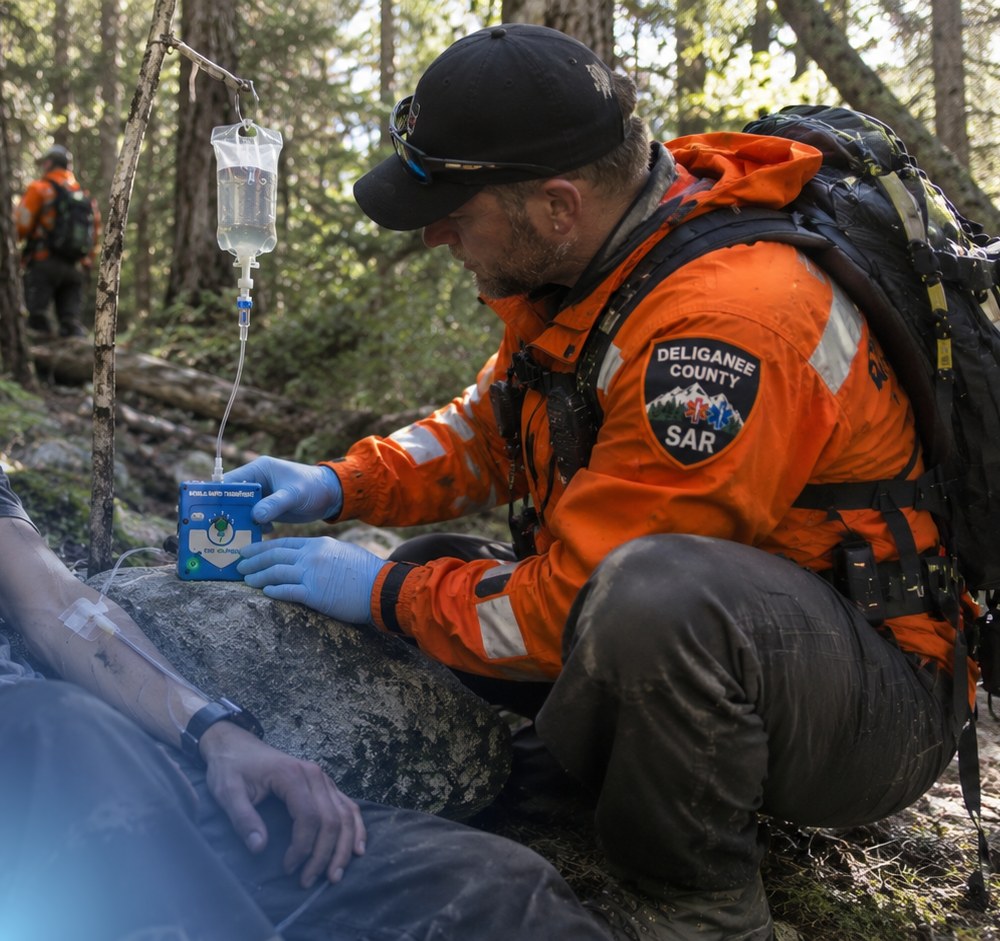
What a provider can reach for, from the pack to the pole.
| Device | Moves fluid | Flow | Hands free | Power | Weight |
|---|---|---|---|---|---|
Pressure bag Standard 300 mmHg cuff |
Pushes by bag pressure | About 257 mL/min at 300 mmHg, falling as it deflates | No, re-pump by hand | None, inflated by hand | n/a |
Field warmers In-line, battery-powered |
No, warms only | Pass-through, 80 to 180 mL/min maximum | n/a | Battery, for heat | 0.26–1.7 kg |
Hand-operated infuser Syringe type, single use |
Yes, hand pump | One unit in about two minutes, operator-dependent | No, one hand pumps | None, pumped by hand | 227 g |
MRT Auto Medic Systems |
Yes, powered | 100 / 200 / 300 mL/min settings1 | Yes | 12 V battery, 67.2 Wh | 696 g |
Hospital rapid infusers Pole-mounted |
Yes, powered | Up to 1,000–1,400 mL/min | Yes | Wall power | 12.7–28.5 kg |
Competitor figures from published specifications.2
lighter than a 12.7 kg hospital rapid infuser, and 41× lighter than one at 28.5 kg.2
A powered pump, small enough for the pack.
No re-pumping
A pressure bag falls off as it deflates and has to be pumped up again. A motor-driven pump does not.
Both hands free
A hand-operated infuser keeps one hand pumping. The MRT runs on its own once the button is pressed.
A rate you set
The knob is marked 1, 2 and 3 for 100, 200 and 300 mL/min nominal. A pressure bag has no rate setting.
No wall power
It runs on its own 12 V, 67.2 Wh battery. Hospital rapid infusers are built around wall power and an IV pole.
Concept imagery above. The MRT is a prototype. It is not FDA cleared and not for clinical use.
A market arriving.
ground EMS agencies carrying blood products for 911 calls, June 2026.3
The pull is coming from every direction. Tactical Combat Casualty Care lists whole blood first for hemorrhagic shock. Norway's air ambulances carry it. London's air ambulance has flown with blood since 2012. Israel transfuses whole blood at the point of injury. In Colorado, fifteen fire and EMS agencies launched programs in two years, volunteer mountain-rescue teams among them.5